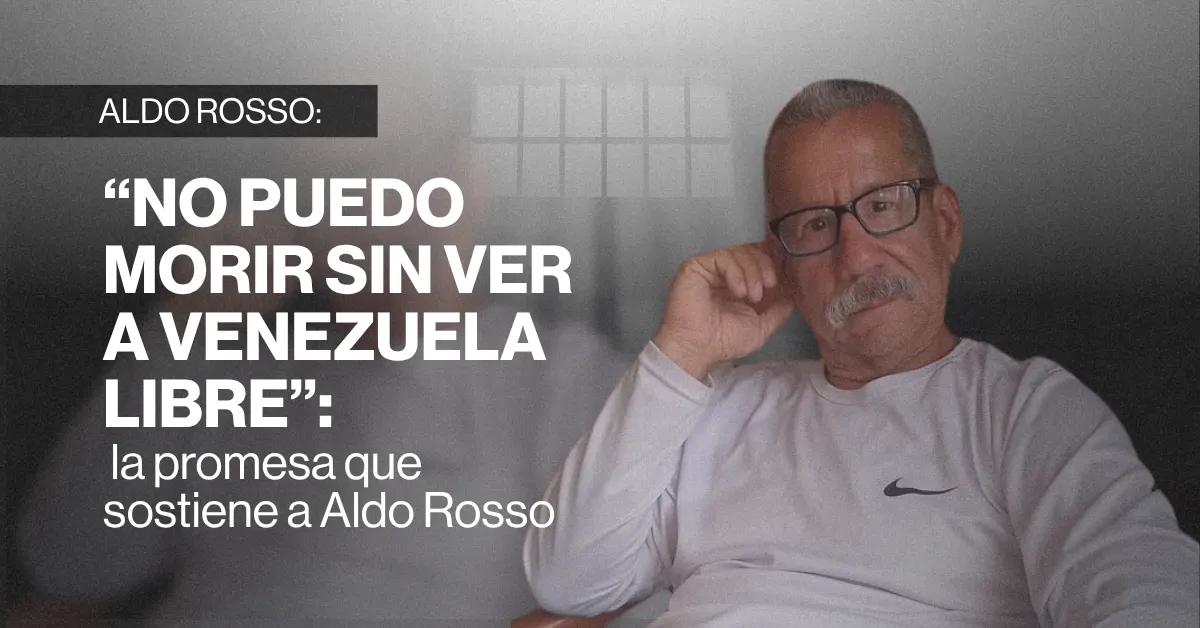
“I need you strong”: What sustains Aldo Rosso after a year in prison
Voluntad Popular tells the story of Aldo Rosso, a 70-year-old party activist from El Valle, Caracas, detained on July 4, 2024, and accused without evidence of sabotaging the national power grid, through the account of his daughter, Jyuli.
Originally published by Voluntad Popular ·
Written by Staff, Voluntad Popular
Republished by Eyleen Valiente ·
Read the original: voluntadpopular.com/yo-te-necesito-fuerte-lo-que-sostiene-a-aldo-rosso-tras-un-ano-preso
On the morning of July 4, 2024, Aldo Rosso left his home in El Valle, Caracas, impeccably dressed as always and after having a cup of coffee. He said goodbye with a hug, as he did every time he went out, and gave his blessing to his daughter, Jyuli, who looked at him with the same confidence as always: that of knowing he would be back in a few hours.
“I’m going to the meeting and I’ll be back,” he told her.
She stayed home waiting, as she did every afternoon. She waited for the message, the call, the sound of the door. But that afternoon—and every one that has followed since—only silence came.
“I felt like they had torn my soul out,” Jyuli says now, her voice breaking.
Almost 36 hours had to pass before anyone confirmed to them that Aldo had been detained. They did not know why, or who had taken him, or where they were holding him. They only knew he was gone. The uncertainty lasted six days. Until, from a distance, from the street, Jyuli managed to see him at the Bolivarian National Police (PNB) headquarters in Maripérez.
“He was standing, thin, more hunched over than before. All I could think was: why isn’t he coming home? What did they do to him? What is going to happen now?”
Then she knew that her greatest fear had come true: Nicolás Maduro’s regime had kidnapped her father simply for thinking differently.
It should never have happened
Aldo Rosso turned 70 behind bars. He should not have. Venezuelan law establishes that older adults of that age must not remain detained in pretrial detention centers. But there he remains: in a cell of the PNB in La Yaguara, accused by the regime, without evidence, of taking part in an alleged sabotage of the national power grid.
Jyuli insists that her dad never even made it to a meeting called that day for the start of the presidential campaign. They intercepted him near his home, without a court order, without witnesses, without explanations. For six days, the family did not even know whether he was alive.
“When they finally let me see him, he didn’t seem like himself,” she says. “He had lost weight; he told me they had kept him isolated, in a cell they call ‘La Pecera’ (the Fishbowl), without food, without water.”
La Pecera is a glass cell located inside the headquarters of the Directorate of Criminal Investigations at El Helicoide. It is an enclosed space, without adequate ventilation, visible from outside, where detainees are under constant observation, according to human rights defenders. There is no privacy or rest.
In those conditions, without regular meals or access to water, Aldo’s health began to deteriorate rapidly.
An exemplary Venezuelan
In his community of El Valle he is known as a master builder, as a man who helps others, as the neighbor who looks for solutions for others even when he himself has nothing. He never went to university, but he knew how to read blueprints and build houses with his hands. “He has the university of life,” his daughter says.
He worked at PDVSA Gas for years. He was a foreman, a crew chief. Until he signed against Chávez and was fired. From then on he knew that thinking differently in Venezuela was becoming a crime. But far from frightening him, the idea drove him to enter politics to change that reality.
From then on he joined the Voluntad Popular party and became a constant activist. “I will not rest until I see Venezuela free,” he would tell Jyuli. “I don’t want to go without seeing that you can live the way I once lived: with work, with dignity, with a future. I want to leave all that to you, so that you instill it in my grandchildren.”
That conviction remains intact, despite everything.
“Every time I visit him he tells me the same thing: ‘I need you strong. If you break, I’ll sink in here.’”
They are waiting for him at home
The house is quieter without him. Only Jyuli and her two children live there: a 13-year-old boy, who has had to understand more than he should at his age, and a 3-year-old girl, who still cannot understand what is happening.
“She calls him ‘dad,’ because he is the father figure she has had. She goes into his room, lies down on his bed, asks if he’s back yet. We tell her he’s on a trip, that he’ll be back soon. But she feels that emptiness, she feels it all the time.”
What Jyuli also does not understand is why the case remains stalled. The case file is there, with no trial opened. The prosecutors resign, the judges are replaced, the medical report that could justify his release on health grounds has not arrived.
“He has hypertension, diabetes, a hernia that hurts him every day. But they haven’t even authorized his transfer to a hospital.”
In February, a forensic doctor went to see him. He examined him. He promised to deliver the report. Nothing has happened since then.
Amid so much injustice, Aldo can at least receive visits from his relatives, a right he knows is not guaranteed to all political prisoners like him. The visits are brief, not enough to ease the pain, but at the same time comforting.
When the pain overwhelms him, when he tells her he can’t take it anymore, that he needs to get out to work, to go out with his grandchildren, Jyuli listens to Aldo patiently. Then she hugs him and reminds him that he is not alone.
“We are alive,” she tells him. “And that is what matters now.”
Then he takes a deep breath, wipes away his tears and answers her:
“Yes, you’re right. It’s for them that I keep standing firm.”
Aldo Rosso’s goal remains the same as before he was imprisoned: to see Venezuela free. For him, the struggle is not abstract. It has names, faces, empty rooms. And a little girl who still waits for him in his bed every night.