
Investigation · Part two
The Capacity to Persecute Is Still There
What the Venezuelan State can still do after January 2026, and what guarantees exist that it will stop
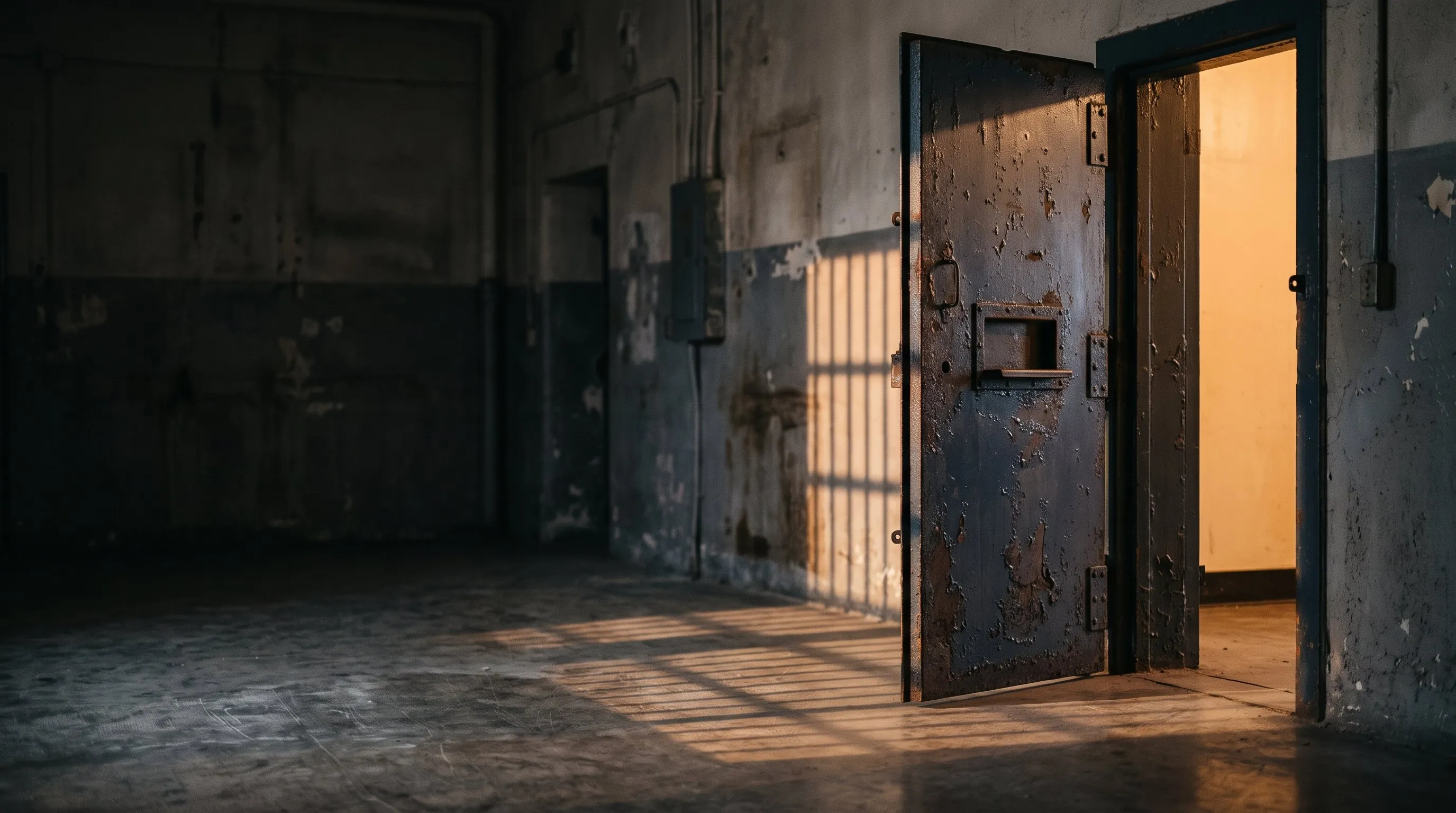
AI-generated illustration (Google Flow) for Venezuela Record.
1,104releases of political prisoners verified in 2026
11,468people still live with their freedom restricted by the courts
Foro Penal, figures as of 5 October 20261
Original idea: Minerva Mendoza Paipa. Research and editing: Venezuela Record.
Part oneVenezuela 2026: The Post-Maduro Power StructureThe figures
More than a thousand released. How many are still not free?
Foro Penal counts four different things. Mixing them hides what matters: fewer people in prison does not mean fewer people persecuted.
Each figure links to the dated Foro Penal page that reports it. The “Repression in figures” page updates itself, so the series uses the weekly balances, which do not change. The historical total of detentions since 2014 (19,253) also grows with late-reported cases, so it is not presented as new arrests.2
The sum that does not add up. Between 28 January and 5 October Foro Penal verified 802 releases, but the number of political prisoners fell by only 389. The difference, 413 people, are new detentions and cases nobody had reported before.Our calculation with Foro Penal figures: (1,104 − 302) − (711 − 322) = 413. Foro Penal records 32 new jailings in 2026; the rest are late-reported cases.
See every figure with its link to Foro Penal
| Cut date | Political prisoners | Cumulative releases |
|---|---|---|
| 17 Jan 2026 | 270 | |
| 28 Jan 2026 | 711 | 302 |
| 2 Feb 2026 | 687 | |
| 15 Feb 2026 | 444 | |
| 20 Feb 2026 | 452 | |
| 26 Feb 2026 | 568 | |
| 2 Mar 2026 | 526 | 621 |
| 8 Mar 2026 | 670 | |
| 9 Mar 2026 | 508 | |
| 13 Mar 2026 | 690 | |
| 23 Mar 2026 | 503 | |
| 30 Mar 2026 | 490 | |
| 6 Apr 2026 | 485 | |
| 20 Apr 2026 | 473 | |
| 21 Apr 2026 | 786 | |
| 27 Apr 2026 | 454 | |
| 25 May 2026 | 409 | |
| 1 Jun 2026 | 404 | |
| 9 Jun 2026 | 389 | |
| 12 Jun 2026 | 894 | |
| 6 Jul 2026 | 372 | |
| 27 Jul 2026 | 379 | |
| 3 Aug 2026 | 382 | |
| 10 Aug 2026 | 391 | |
| 31 Aug 2026 | 328 | |
| 14 Sep 2026 | 344 | |
| 28 Sep 2026 | 324 | |
| 5 Oct 2026 | 322 | 1,104 |
Three questions
What it can do, what it did, what could happen again
Three things have to be kept apart: what the State can still do, what it did in 2026 and the risk that it does it again. Mixing them is the usual mistake: fewer prisoners does not mean less risk.
Residual capacity to persecute: the verifiable persistence of legal powers, institutional structures and operational means that allow the State to identify, investigate, restrict or sanction people arbitrarily for political reasons, even after a change of leadership or a documented drop in detentions.
1Available capacity
Norms, bodies, powers and resources that remain. A status only changes with a verifiable official act.
Norms in force
Anti-Hate LawConstitutional law, 2017
Formal change- January 2026
- In force and applied by the courts
Liberator Simón Bolívar Organic LawOrganic law, Nov 2024
Unchanged- January 2026
- In force
- October 2026
- In force, no known reform31
Amnesty LawOfficial Gazette 6,990, 19 Feb 2026
Unchanged- January 2026
- Did not exist
Bodies and means that remain
- 4 of 11Unchanged
- 2 of 11To be verified
- 1 of 11Formal change
- 3 of 11New head
- 1 of 11Abolished
Presidency
New head- January 2026
- Nicolás Maduro, captured on 3 January
National Assembly
Unchanged- January 2026
- Jorge Rodríguez
- October 2026
- Jorge Rodríguez34
Interior, Justice and Peace
Unchanged- January 2026
- Diosdado Cabello
Defense
New head- January 2026
- Vladimir Padrino López, minister since 2014
- October 2026
- Gustavo González López, since 18 March16
DGCIMmilitary counterintelligence
New head- January 2026
- Gustavo González López, from 6 January (SEBIN chief 2019–2024)
SEBINintelligence
To be verified- January 2026
- Alexis Rodríguez Cabello, since October 2024
- October 2026
- No confirmation after March 202617
CESPPAstrategic intelligence centre
Abolished- January 2026
- Existed
- October 2026
- Abolished by Decree 5,248 (9 February)17
CICPCcriminal police
Unchanged- January 2026
- Douglas Rico, in office since 2016
- October 2026
- Douglas Rico30
Supreme Court (TSJ)
Formal change- January 2026
- 20 justices
Courts and Prosecutor’s Office
Unchanged- January 2026
- Judges and prosecutors of the political cases
VenAppoperational tool
To be verified- January 2026
- Active, with an anonymous reporting channel since 2024
2Documented exercise
Detentions, investigations, restrictions and actions verified in 2026. No names of affected people.
- 13 Jan
SEBIN detains a citizen over a TikTok comment about Maduro’s capture and charges him with “incitement to hatred.”22
- Feb–Mar
Courts refuse to accept amnesty requests or to hand over copies of their rulings, Foro Penal reports.10
- 23 Apr
The Executive declares the amnesty over. Only 24% of the releases had come from it.217
- 3 Sep
94 political prisoners are moved out of Rodeo I without notice; Foro Penal could confirm where only 24 went.12
- 16 Sep
The UN Fact-Finding Mission concludes that, despite limited political changes, the repressive apparatus remains intact.1514
- 17 Sep
An opposition leader is detained 48 hours after returning from exile and released about six hours later.2324
- Jan–Oct
32 new political jailings, while 11,468 people remain under measures that restrict their freedom.1
3Risk of repetition
An inference, not a prediction: it depends on the person’s profile, their record and whether effective guarantees exist.
The guarantees: what Foro Penal requested and what the State did
Every row is a reform Foro Penal submitted to the National Assembly on 7 February, set against the Amnesty Law published on 19 February.34
- 3 of 8Not carried out
- 1 of 8Not verifiable
- 4 of 8Partly carried out
- 0 of 8Carried out
Absolute nullity of the cases and all their effects
Not carried outFull restoration of civil, political, administrative and property rights
Not carried outRepeal the norms used to persecute
Not carried outErase all criminal records and registries
Not verifiableAutomatic application, without delay
Partly carried outBreadth: civilians and military, the whole period
Partly carried outOversight with binding participation of NGOs and victims
Partly carried out- What the State did
- A special committee of the National Assembly with expert support (art. 15), with no binding participation.4
Keep releasing people and turn releases into full freedom
Partly carried out- What the State did
- Releases continued (1,104 in 2026), but 11,468 people remain under restrictive measures.1
23 April: the Executive declared the Amnesty Law over. Foro Penal answered that the law had no expiry date and that only the National Assembly can repeal it.2189
When the capacity still matters
Our criteria to decide whether a capacity is still relevant to assess a risk. Each one with its example from 2026.
- 1
In force
The norm or body is still in force under an official act: it was neither repealed nor annulled.
In 2026: The Anti-Hate Law is still in force in October 2026.35
- 2
Same chain of command
It is run by the same people, or by people appointed through the same chain.
In 2026: The new DGCIM chief was appointed by decree signed by the acting president alone.32
- 3
Documented use after the change
It was applied after January 2026.
In 2026: A detention for “incitement to hatred” over a TikTok comment, on 13 January.22
- 4
No effective oversight
No independent judge, external body or victims’ mechanism can stop it.
In 2026: Courts refused to accept amnesty requests.10
- 5
Reversible improvement
The improvement depends on a decision that can be undone, not on a firm legal change.
In 2026: The Executive declared the amnesty over on 23 April.21
Where the criteria weigh more
- People released with an open case or precautionary measures, without nullity
- Groups excluded from the amnesty: military personnel, offences under article 9
- People with a prior detention or a record that was not erased
- Visible political or journalistic activity
- People returning from exile
Groups, never individuals. “Arbitrary” follows the categories of the UN Working Group on Arbitrary Detention.
Method
How we did it
This piece relies on Foro Penal’s weekly balances and documents, the text of the Amnesty Law published in the Official Gazette, the 2026 report of the UN Fact-Finding Mission and verified press reports. Every figure carries its cut date and links to the page that reports it. A status in the matrix only changes with a verifiable official act: a gazette, a decree or a ruling. The risk of repetition is an inference based on explicit criteria, never a prediction about a specific person, so we speak of groups and not of personal cases.
Available capacity does not by itself prove it will be used. Allegations are cited as what they are: attributed to whoever makes them. Foro Penal’s figures are its own verified counts; the government has not published the list of people granted amnesty.
Original idea: Minerva Mendoza Paipa. Research and editing: Venezuela Record.
Sources and posts last checked on 20 October 2026.
Found an error? Write to us through our corrections page. We reply within 7 days.
Sources (36)
- Foro Penal The repression in figures (page updated continuously; figures as of 5 Oct 2026) · 5 Oct 2026
- Foro Penal Political prisoners in Venezuela as of 5 October 2026 (weekly balance) · 9 Oct 2026
- Foro Penal Proposed amendments to the draft Amnesty Law for Democratic Coexistence, submitted to the National Assembly (PDF) · 7 Feb 2026
- Gaceta Oficial Official Gazette No. 6,990 Extraordinary (19 Feb 2026): Amnesty Law for Democratic Coexistence (copy published by Foro Penal) · 19 Feb 2026
- Foro Penal Report on political repression in Venezuela, January–February 2026 (PDF) · 13 Mar 2026
- Foro Penal “The Amnesty Law is a positive step, but the repressive apparatus remains intact” · 20 Feb 2026
- Foro Penal / EFE Less than 25% of the releases in Venezuela are due to the amnesty · 22 Apr 2026
- Foro Penal Foro Penal on the repeal of the Amnesty Law · 24 Apr 2026
- Foro Penal / Versión Final Foro Penal warns that only Parliament can repeal the amnesty law · 24 Apr 2026
- Foro Penal / El Diario Foro Penal questions courts’ refusal to accept amnesty requests · 23 Feb 2026
- Foro Penal 894 political prisoners released since 8 January (cites the official figure of 8,740 “full freedoms”) · 12 Jun 2026
- Foro Penal / Unión Radio Foro Penal reports the transfer of 94 political prisoners out of Rodeo I · 3 Sep 2026
- Foro Penal The Supreme Court renewal must include changes to the judicial structure · 20 Oct 2026
- UN Human Rights Council Independent International Fact-Finding Mission on Venezuela, report A/HRC/63/57 (advance edited version) · 17 Aug 2026
- OHCHR Venezuela: Amidst limited political changes, country’s repressive apparatus remains intact, UN Fact-Finding Mission says · 16 Sep 2026
- El Imparcial Delcy Rodríguez removed Vladimir Padrino López after 12 years and appointed Gustavo González López · 19 Mar 2026
- Efecto Cocuyo SEBIN, DGCIM and CESPPA under Delcy Rodríguez (fact check) · 5 Mar 2026
- InSight Crime Profile: Diosdado Cabello
- La Nación (Paraguay) Venezuela’s acting president adds the daughter of the powerful interior minister to her cabinet · 2 Feb 2026
- Infobae Parliament approves increasing the number of Supreme Court justices · 5 May 2026
- El Nacional Delcy Rodríguez ends the Amnesty Law and moves ahead with a judicial reform · 23 Apr 2026
- El Tiempo A Venezuelan remains detained for a TikTok comment on Maduro’s capture, NGO says · 8 Apr 2026
- El Pitazo PNB detains former mayor Javier Oropeza 48 hours after his return to the country · 17 Sep 2026
- Infobae Opposition leader Javier Oropeza released after arbitrary detention · 18 Sep 2026
- Telemundo 51 “There was abusive use”: Delcy Rodríguez asks to reform the anti-hate law · 30 Sep 2026
- La Tercera VenApp: Amnesty questions the app Maduro uses to receive reports against opponents · 7 Aug 2024
- Wikimedia Commons Official Gazette No. 6,957 Extraordinary (6 Jan 2026): Decree 5,203 · 6 Jan 2026
- Acceso a la Justicia The Constitutional Chamber orders Delcy Rodríguez to take over the presidency (ruling No. 1) · 3 Jan 2026
- Efecto Cocuyo Why hasn’t Delcy Rodríguez appointed an executive vice president? · 19 Apr 2026
- RNV CICPC director Douglas Rico reviews operational progress · 26 Aug 2026
- Gaceta Oficial Official Gazette No. 6,859 Extraordinary (29 Nov 2024): Liberator Simón Bolívar Organic Law · 29 Nov 2024
- Wikimedia Commons Official Gazette No. 7,006 Extraordinary (18 Mar 2026): Decree 5,284, appointment of the DGCIM director · 18 Mar 2026
- Maldita.es VenApp, the app the Venezuelan government uses to report citizens · 31 Jul 2024
- Chequeado / Factchequeado Who is Delcy Rodríguez, Venezuela’s interim president after Nicolás Maduro’s capture · 5 Jan 2026
- El Nacional The Supreme Court endorses the reform of the anti-hate law and lets the National Assembly continue the debate (ruling No. 1034) · 15 Oct 2026
- El Nacional VenApp and a phone line activated to report missing people after the double earthquake · 27 Jun 2026
Source 1 · Foro Penal · 5 Oct 2026
The repression in figures (page updated continuously; figures as of 5 Oct 2026)
Source 2 · Foro Penal · 9 Oct 2026
Political prisoners in Venezuela as of 5 October 2026 (weekly balance)
Source 3 · Foro Penal · 7 Feb 2026
Proposed amendments to the draft Amnesty Law for Democratic Coexistence, submitted to the National Assembly (PDF)
Source 4 · Gaceta Oficial · 19 Feb 2026
Official Gazette No. 6,990 Extraordinary (19 Feb 2026): Amnesty Law for Democratic Coexistence (copy published by Foro Penal)
Source 5 · Foro Penal · 13 Mar 2026
Report on political repression in Venezuela, January–February 2026 (PDF)
Source 6 · Foro Penal · 20 Feb 2026
“The Amnesty Law is a positive step, but the repressive apparatus remains intact”
Source 7 · Foro Penal / EFE · 22 Apr 2026
Less than 25% of the releases in Venezuela are due to the amnesty
Source 8 · Foro Penal · 24 Apr 2026
Foro Penal on the repeal of the Amnesty Law
Source 9 · Foro Penal / Versión Final · 24 Apr 2026
Foro Penal warns that only Parliament can repeal the amnesty law
Source 10 · Foro Penal / El Diario · 23 Feb 2026
Foro Penal questions courts’ refusal to accept amnesty requests
Source 11 · Foro Penal · 12 Jun 2026
894 political prisoners released since 8 January (cites the official figure of 8,740 “full freedoms”)
Source 12 · Foro Penal / Unión Radio · 3 Sep 2026
Foro Penal reports the transfer of 94 political prisoners out of Rodeo I
Source 13 · Foro Penal · 20 Oct 2026
The Supreme Court renewal must include changes to the judicial structure
Source 14 · UN Human Rights Council · 17 Aug 2026
Independent International Fact-Finding Mission on Venezuela, report A/HRC/63/57 (advance edited version)
Source 15 · OHCHR · 16 Sep 2026
Venezuela: Amidst limited political changes, country’s repressive apparatus remains intact, UN Fact-Finding Mission says
Source 16 · El Imparcial · 19 Mar 2026
Delcy Rodríguez removed Vladimir Padrino López after 12 years and appointed Gustavo González López
Source 17 · Efecto Cocuyo · 5 Mar 2026
SEBIN, DGCIM and CESPPA under Delcy Rodríguez (fact check)
Source 19 · La Nación (Paraguay) · 2 Feb 2026
Venezuela’s acting president adds the daughter of the powerful interior minister to her cabinet
Source 20 · Infobae · 5 May 2026
Parliament approves increasing the number of Supreme Court justices
Source 21 · El Nacional · 23 Apr 2026
Delcy Rodríguez ends the Amnesty Law and moves ahead with a judicial reform
Source 22 · El Tiempo · 8 Apr 2026
A Venezuelan remains detained for a TikTok comment on Maduro’s capture, NGO says
Source 23 · El Pitazo · 17 Sep 2026
PNB detains former mayor Javier Oropeza 48 hours after his return to the country
Source 24 · Infobae · 18 Sep 2026
Opposition leader Javier Oropeza released after arbitrary detention
Source 25 · Telemundo 51 · 30 Sep 2026
“There was abusive use”: Delcy Rodríguez asks to reform the anti-hate law
Source 26 · La Tercera · 7 Aug 2024
VenApp: Amnesty questions the app Maduro uses to receive reports against opponents
Source 27 · Wikimedia Commons · 6 Jan 2026
Official Gazette No. 6,957 Extraordinary (6 Jan 2026): Decree 5,203
Source 28 · Acceso a la Justicia · 3 Jan 2026
The Constitutional Chamber orders Delcy Rodríguez to take over the presidency (ruling No. 1)
Source 29 · Efecto Cocuyo · 19 Apr 2026
Why hasn’t Delcy Rodríguez appointed an executive vice president?
Source 30 · RNV · 26 Aug 2026
CICPC director Douglas Rico reviews operational progress
Source 31 · Gaceta Oficial · 29 Nov 2024
Official Gazette No. 6,859 Extraordinary (29 Nov 2024): Liberator Simón Bolívar Organic Law
Source 32 · Wikimedia Commons · 18 Mar 2026
Official Gazette No. 7,006 Extraordinary (18 Mar 2026): Decree 5,284, appointment of the DGCIM director
Source 33 · Maldita.es · 31 Jul 2024
VenApp, the app the Venezuelan government uses to report citizens
Source 34 · Chequeado / Factchequeado · 5 Jan 2026
Who is Delcy Rodríguez, Venezuela’s interim president after Nicolás Maduro’s capture
Source 35 · El Nacional · 15 Oct 2026
The Supreme Court endorses the reform of the anti-hate law and lets the National Assembly continue the debate (ruling No. 1034)
Source 36 · El Nacional · 27 Jun 2026
VenApp and a phone line activated to report missing people after the double earthquake